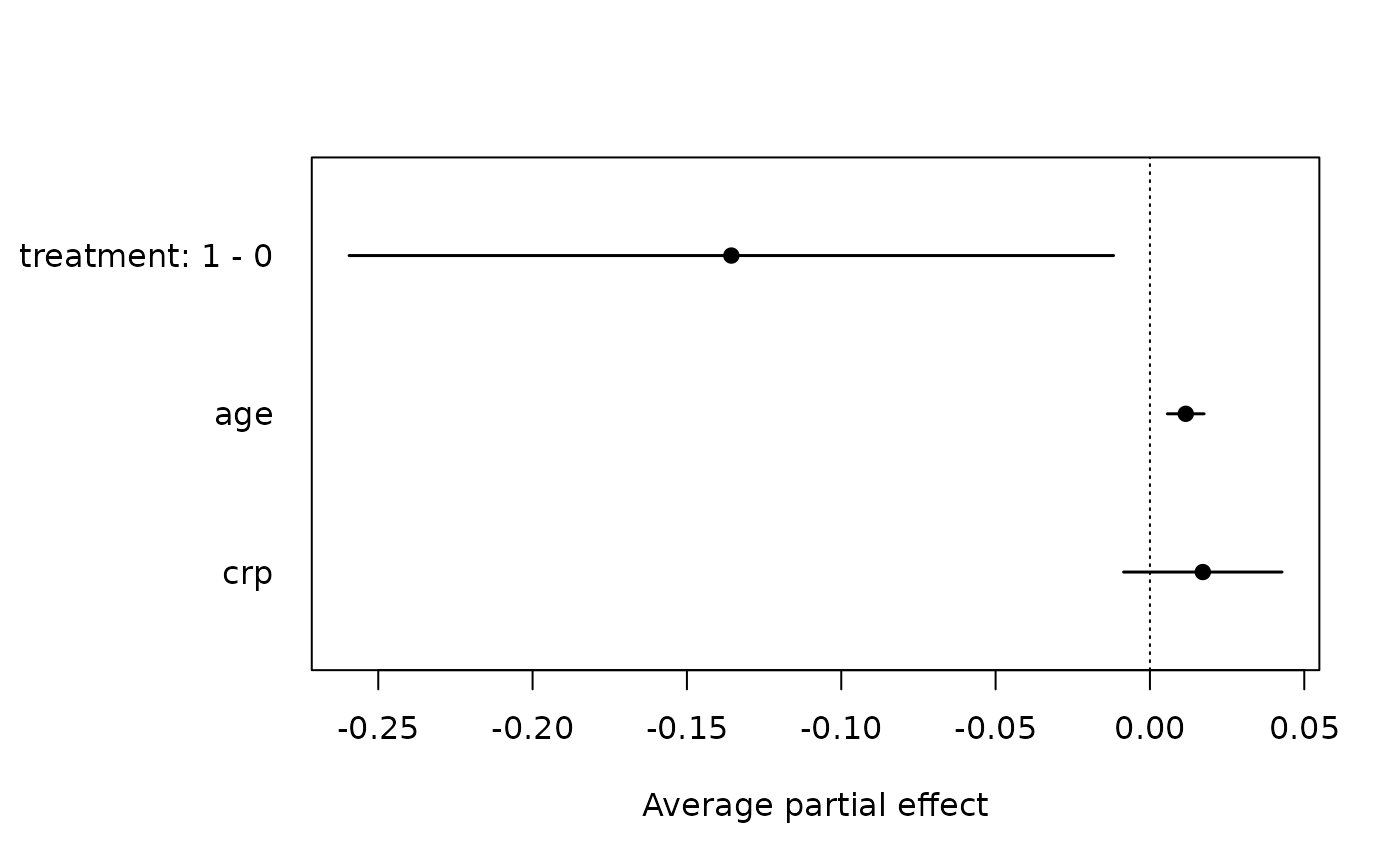
Average partial effects (APE, also called average marginal effects) of each regressor on the expected outcome, with delta-method standard errors. For a continuous regressor the APE is the sample average of the derivative of the mean with respect to that regressor; for a binary (0/1 or logical) regressor and for each non-reference level of a factor it is the sample average of the discrete change in the mean, all other regressors held at their observed values. Derivatives and changes are taken through the model formula, so interactions, polynomial terms and factor codings are handled automatically.
Usage
# S3 method for class 'panordered'
partialeffects(object, variables = NULL, level = 0.95, ...)

partialeffects(object, ...)

# S3 method for class 'panglm'
partialeffects(object, variables = NULL, level = 0.95, ...)

# S3 method for class 'twopart'
partialeffects(
  object,
  variables = NULL,
  level = 0.95,
  part = c("total", "binary", "positive"),
  ...
)
Arguments
- object
a
"panglm"or"twopart"fit- variables
character vector of variable names (as they appear in the data); defaults to every regressor in the model formula(s)
- level
confidence level for the Wald intervals
- ...
unused
- part
for two-part models:
"total"(the unconditional mean),"binary"(the probability of a positive outcome) or"positive"(the mean conditional on a positive outcome)
Value
a data frame of class "panglm_ape" with columns term,
contrast, estimate, std.error, statistic, p.value,
conf.low and conf.high, one row per continuous or binary regressor
and one row per non-reference factor level.
Details
The mean used is the one returned by predict(type = "response"):
the GLM mean for pooled models; the mean including the estimated
individual (and time) effects for fixed-effects models; and the
population-averaged mean (integrating over the random intercept, and
the random slopes when random has slope variables) for
random-effects models, which is the average structural function of
Wooldridge (2005). For correlated random effects fits (cre = TRUE) the
individual means are held fixed, so the APE of a time-varying regressor
is the within-individual effect. For two-part models the mean is
P(y > 0) * E[y | y > 0] (or one of its parts, see part).
Standard errors use the covariance stored on the fit (so a fit made with
vcov = "cluster" gives cluster-robust APE standard errors) and treat
variance components, dispersion and fixed-effect intercepts as fixed.
Exact conditional logit fits are not supported, because their
individual intercepts are conditioned out and the mean is not identified.
Validation
Numerical accuracy is checked in the package tests and in the validation suite; see the validation article on the package website.
References
Wooldridge, J. M. (2005). Unobserved heterogeneity and estimation of average partial effects. In Identification and Inference for Econometric Models, Cambridge University Press.
See also
plot.panglm_ape() for a dot-and-whisker chart, and effectcurve()
for the effect of a regressor across its range on the link, response or
slope scale.
Other panglm methods:
coefplot(),
confint.panglm(),
effectcurve(),
fitted.panglm(),
fixef(),
glance.panglm(),
logLik.panglm(),
model.matrix.panglm(),
plot.panglm(),
plot.panglm_ape(),
plot.panglm_effectcurve(),
predict.panglm(),
predict.panordered(),
residuals.panglm(),
summary.panglm(),
tidy.panglm(),
vcov.panglm()
Examples
data(copd)
fit <- panglm(hospitalized ~ treatment + age + crp, data = copd,
              index = c("id", "visit"), model = "random",
              family = "probit", cre = TRUE)
ape <- partialeffects(fit)
ape
#>
#> Average partial effects
#> Delta-method standard errors, vcov: classical
#>
#>       term contrast estimate std.error statistic   p.value  conf.low conf.high
#>  treatment    1 - 0 -0.13560  0.063190    -2.146 0.0318600 -0.259500  -0.01176
#>        age    dY/dX  0.01161  0.003042     3.815 0.0001361  0.005644   0.01757
#>        crp    dY/dX  0.01713  0.013100     1.308 0.1909000 -0.008539   0.04280
#>
plot(ape)